
Estuary:
A Harbour Residency
This project takes the harbour as its central concept, exploring cultural migration and shifting identities in an era of global mobility. As points of convergence between rivers and seas, harbours have long shaped trade networks, human movement, and cultural exchange, playing a vital role in the development of cities and civilizations throughout history.
As global supply chains, logistical systems, and patterns of migration continue to be reconfigured, the harbour has re-emerged as a powerful metaphor for understanding the structures of the contemporary world. The project adopts the estuary as a philosophical concept — a space where freshwater and seawater meet, continuously mixing, flowing, and transforming. Within this space, cultures, memories, languages, and identities intersect, collide, and generate new forms of relation.
The Estuary as Method: Artistic Research on Ecology, Infrastructure, and Mobility in the Yangtze River Estuary
In contemporary discussions of globalization, ports are no longer understood solely as sites of transportation and trade. They have become critical spatial frameworks through which we can examine global logistics, migration, ecological transformation, and cultural exchange. Situated between inland territories and the open sea, the estuary occupies a unique position within this framework. It is neither river nor ocean, neither land nor sea, but a dynamic zone of continuous negotiation, mixing, and transformation. Freshwater currents carry sediments, nutrients, memories, and histories downstream, while tides push seawater inland, creating an environment defined by exchange rather than separation. The estuary is therefore not simply a geographical formation but a relational system in constant becoming.
Estuary: A Harbour Residency was developed in response to the Yangtze River Estuary, with a particular focus on the region surrounding Chongming Island near Shanghai. As one of the largest estuarine systems in the world, the Yangtze Estuary functions simultaneously as an ecological habitat, a logistics hub, a site of industrial expansion, and a critical interface between China and global networks of circulation. Massive container terminals, shipping routes, wetlands, migratory bird corridors, engineered waterways, and sedimentary landscapes coexist within the same environment. Rather than treating the estuary as a scenic backdrop, the residency approached it as a research field through which broader questions concerning mobility, infrastructure, materiality, and ecological interdependence could be explored.
The central premise of the residency was that the estuary should not be understood as a location but as a method. It offers a way of thinking about the world through processes of convergence, accumulation, circulation, and transformation. Unlike conventional geographical boundaries that divide one territory from another, the estuary is characterized by ambiguity. It is a space where categories dissolve and where multiple systems overlap. Geological processes intersect with economic systems; ecological rhythms intersect with logistical operations; local histories intersect with global flows of capital and information. The residency sought to engage with this complexity through artistic practices that privilege observation, material investigation, and spatial experimentation.
The Yangtze Estuary itself embodies the tensions and contradictions of contemporary planetary conditions. For thousands of years, sediment transported from inland regions has accumulated at the river mouth, gradually forming islands such as Chongming. Yet these natural processes now unfold alongside large-scale interventions including port construction, dredging operations, land reclamation projects, and industrial development. The estuary is therefore neither entirely natural nor entirely artificial. It exists as a hybrid environment shaped by the interaction of ecological forces and technological infrastructures. This condition became a key point of departure for the artists participating in the residency.
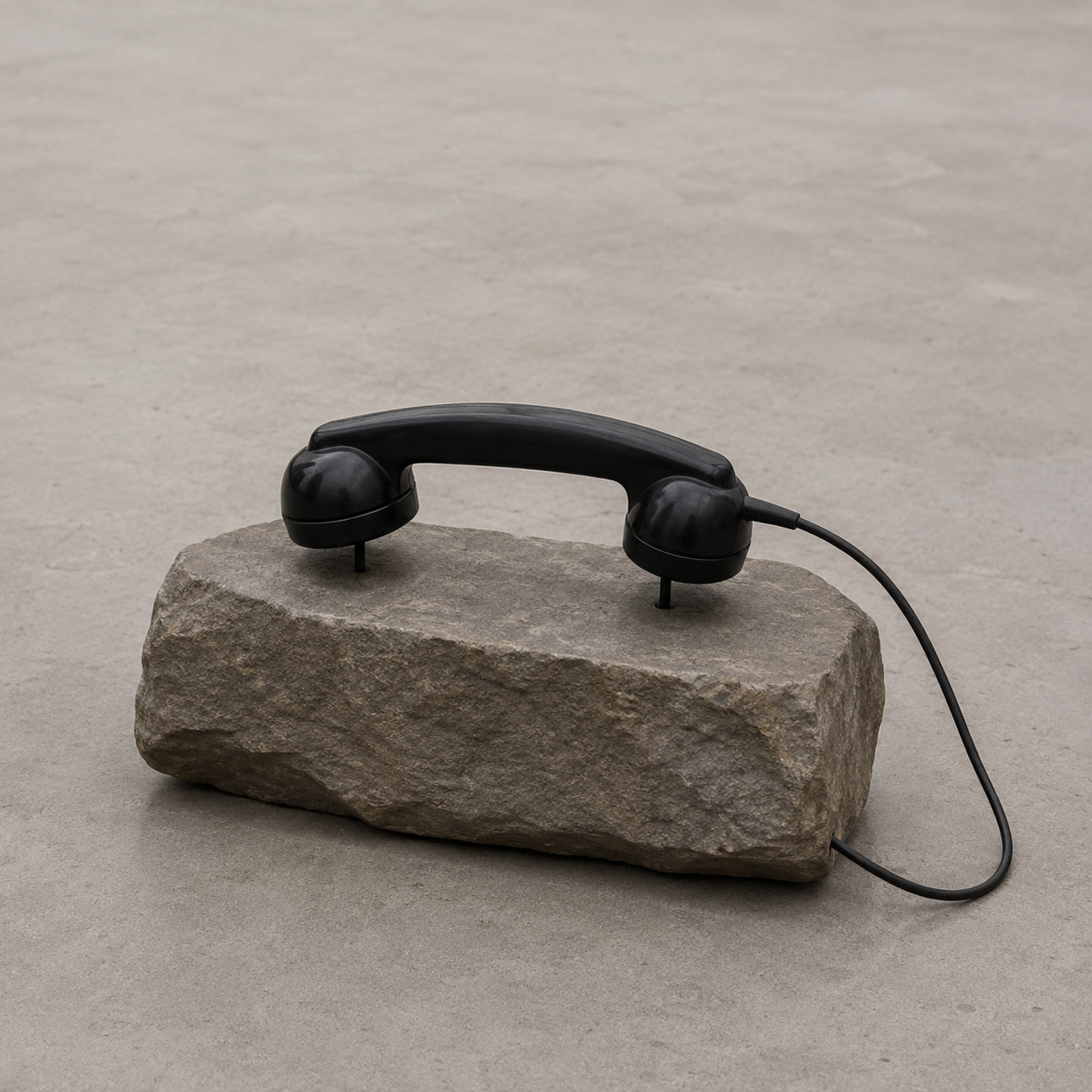
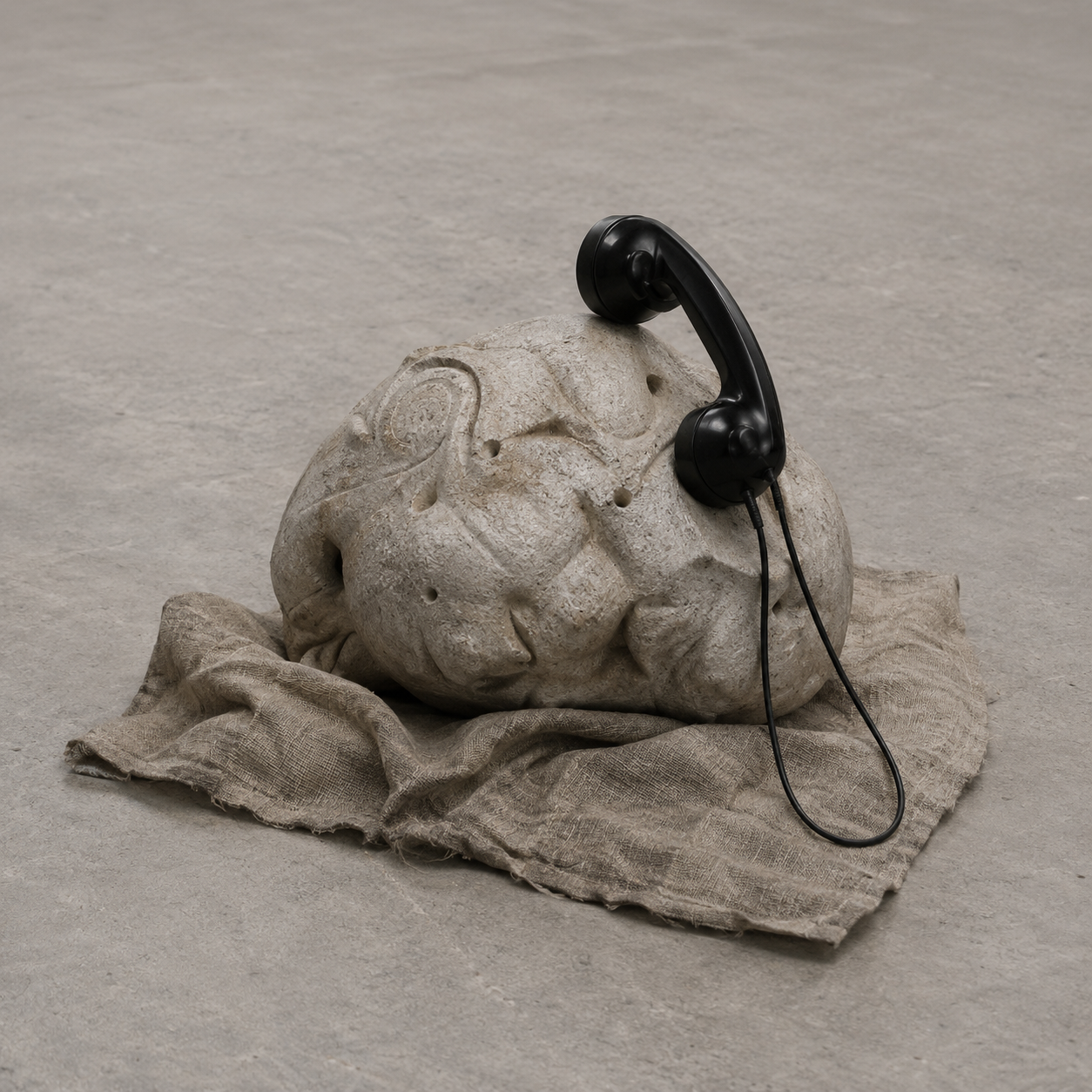
Among the works produced during the residency, a recurring motif was the combination of telephone receivers and stone. In these sculptural assemblages, black telephone handsets are placed upon rough geological forms, establishing a relationship between communication technology and geological matter. At first glance, the juxtaposition appears paradoxical. The telephone symbolizes speed, connectivity, and the transmission of information across vast distances. Stone, by contrast, evokes slowness, permanence, and deep geological time. However, within the context of the estuary, these two objects reveal a shared dependence upon systems of connection.
Modern communication technologies are often imagined as immaterial networks operating within virtual space. Yet every digital signal ultimately relies upon physical infrastructures embedded within landscapes and oceans. Submarine cables, ports, energy grids, server farms, and transportation corridors constitute the material foundations of global communication. The telephone sculptures draw attention to these hidden infrastructures by placing technological objects back into direct contact with geological matter. The works suggest that contemporary connectivity remains inseparable from the physical environments that support it.
At the same time, the telephone appears in a state of suspension. No voice is heard, no conversation takes place, and no communication is completed. The handset becomes a symbol of waiting rather than exchange. This condition resonates strongly with the historical experience of the port itself. Harbours have always been spaces of anticipation: waiting for ships to arrive, waiting for cargo to be unloaded, waiting for letters, messages, migrants, and departures. The estuary is therefore not only a site of movement but also a site of delay. The silent telephone captures this temporal dimension, reminding viewers that every network of connection is equally structured by absence, interruption, and uncertainty.
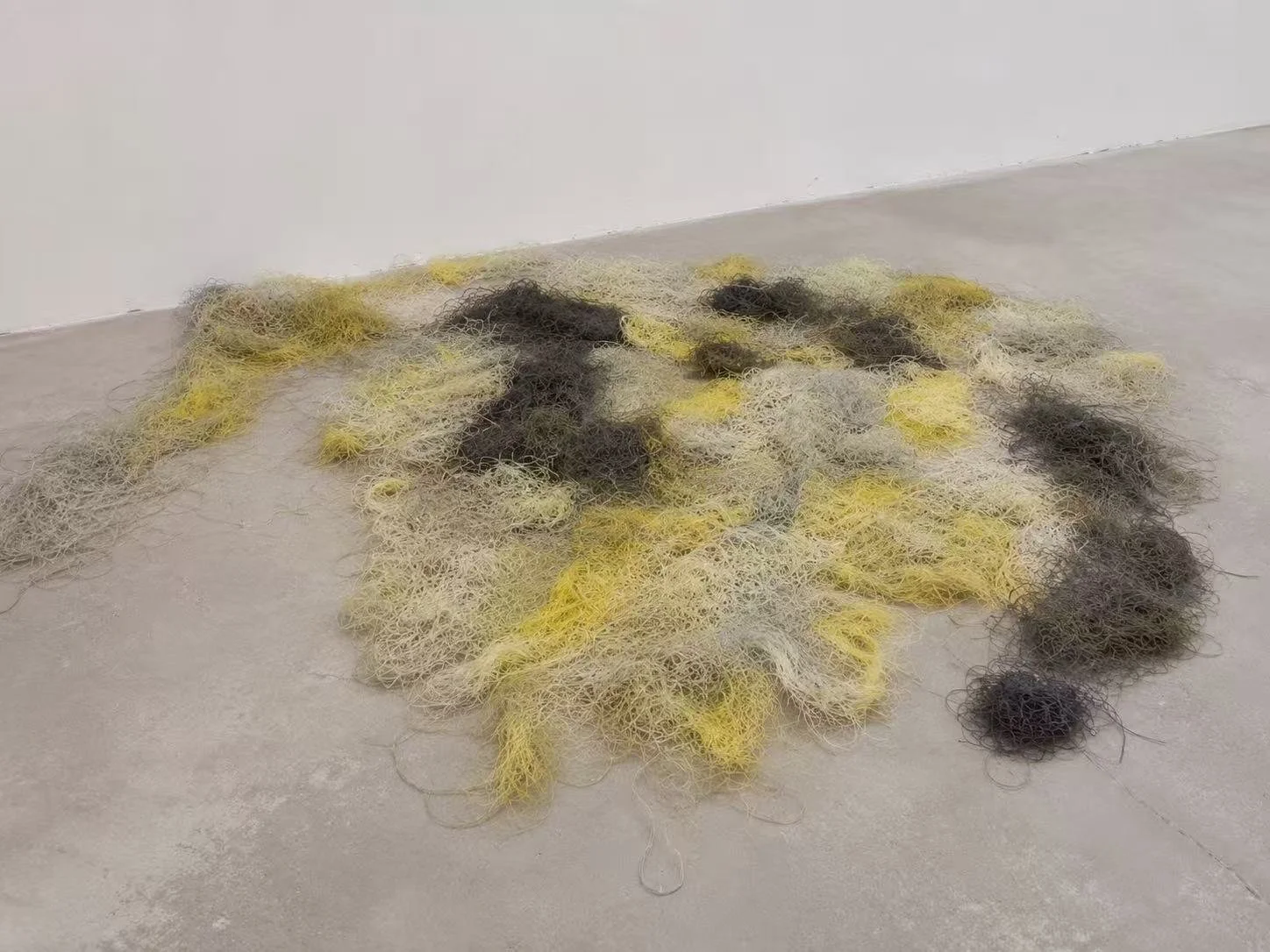
Another group of works consisted of sprawling accumulations of tangled fibrous materials spread across the gallery floor. Their appearance evokes fishing nets, marine debris, seaweed, or sedimentary accumulations left behind by receding tides. These installations emerged from observations of the estuary as a zone of gathering and deposition. Rivers transport materials downstream, tides redistribute them, and coastal currents rearrange them once again. The estuary functions as a vast mechanism of collection in which organic matter, industrial waste, biological life, and geological sediment become entangled.
Rather than representing specific ecological forms, these installations visualize the underlying logic of networked systems. Their tangled structures resemble both ecological assemblages and logistical infrastructures. Just as shipping routes connect distant ports and supply chains link dispersed production sites, the fibrous networks suggest a world held together by invisible relationships. Importantly, these systems have no single center. They operate through distributed connections, continuous movement, and mutual dependency. By transforming these dynamics into sculptural form, the works encourage viewers to consider the estuary not merely as a physical environment but as a model for understanding contemporary systems of circulation.
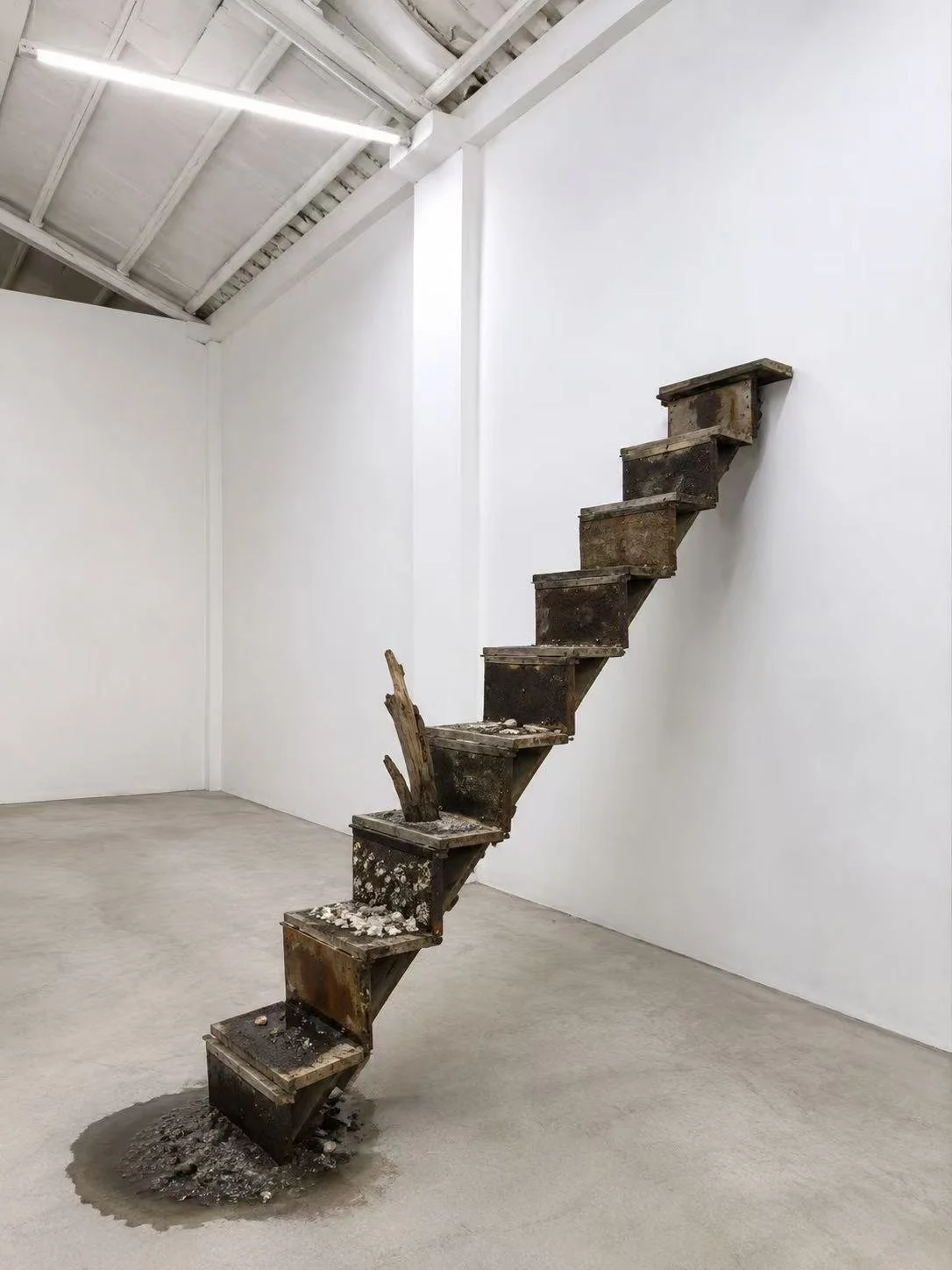
One of the most spatially significant works produced during the residency was a suspended staircase extending upward before disappearing into a gallery wall. Covered in rust, sediment, shells, and traces of corrosion, the structure appears as though it has been retrieved from a tidal zone or abandoned industrial site. The staircase functions as a powerful metaphor for the estuary itself.
Conventionally, stairs imply progress, ascent, and access. They connect one level to another and facilitate movement through space. Yet in this work, the staircase leads nowhere. Its destination remains inaccessible, and its function is rendered impossible. It becomes an infrastructure without a future, a pathway interrupted before completion.
This image resonates deeply with the history of the Yangtze Estuary. Since the nineteenth century, Shanghai has developed as one of the world's most important gateways, facilitating the movement of goods, people, ideas, and technologies between China and the wider world. Mobility has long been central to the identity of the estuary. Yet contemporary forms of mobility are increasingly shaped by political restrictions, environmental crises, economic inequalities, and shifting global conditions. The staircase captures this paradox. It simultaneously represents movement and obstruction, possibility and limitation, connection and disconnection. In doing so, it reflects the unstable realities of movement within the twenty-first century.
Beyond questions of infrastructure and logistics, the residency also addressed the ecological significance of the estuary. The wetlands surrounding Chongming Island form part of the East Asian–Australasian Flyway, one of the world's most important migratory bird routes. Millions of birds rely upon these habitats during seasonal migrations across continents. For these species, the estuary functions not as a border but as a temporary refuge within a larger network of movement.
This ecological perspective influenced the residency's broader approach to artistic production. Rather than focusing exclusively on human narratives, the participating artists sought to engage with a wider field of relationships involving non-human actors, environmental processes, and material agencies. Stones, shells, tides, sediments, birds, industrial debris, telecommunications technologies, and human infrastructures all became participants within a shared ecological framework. Art was approached not as the production of isolated objects but as a method for revealing the complex interdependencies that shape contemporary environments.
Viewed collectively, the works produced during Estuary: A Harbour Residency propose an alternative understanding of the estuary. Rather than treating it as a landscape to be represented, the residency positions the estuary as a conceptual and methodological framework through which contemporary realities can be examined. Within the estuary, multiple temporalities coexist: geological time, ecological time, industrial time, and logistical time overlap and interact. Multiple forms of movement intersect: flows of water, commodities, information, capital, and living organisms become inseparable from one another.
In an era defined by climate change, global migration, ecological instability, and the reconfiguration of supply chains, the estuary offers an especially relevant lens through which to understand the world. It reveals that boundaries are never fixed, that infrastructures remain embedded within ecological systems, and that all forms of connection depend upon complex networks of material relations. The residency therefore sought not to document the estuary as a place, but to inhabit its logic as a condition of thought.
Ultimately, Estuary: A Harbour Residency demonstrates how artistic research can operate within the spaces between disciplines, categories, and territories. By engaging with the Yangtze River Estuary as a site of continuous transformation, the project foregrounds questions of coexistence, circulation, and interdependence that extend far beyond the specific geography of Shanghai. The estuary emerges not simply as a location at the edge of land and sea, but as a model for understanding a world increasingly shaped by mobility, uncertainty, and relational complexity. Like the tidal movements that continually reshape its shoreline, the questions raised by the residency remain open, unfinished, and in motion.
Residency Artists list:
Victoria Yuanli Yuan;
Yuange Sheng;
Yucen Liu;
Jennie L.
T.H.E.M. Gallery Shanghai Residency
Residency: 6 April – 26 June 2026
Final Exhibition: 25 June – 1 July 2026